
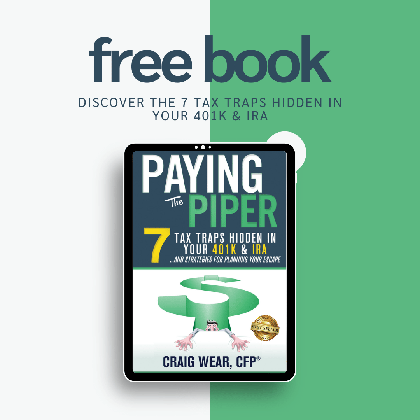
Free Book · Paying the Piper
7 Tax Traps Hidden in Your 401(k) & IRA
Craig Wear's first book names all seven, shows how each one compounds, and gives you the specific moves to get out from under them. Written for people with $1M+ in traditional IRA and 401(k) savings.

Craig Wear, CFP® — Founder, Q3 Advisors. 35+ years in financial planning · 16 years working only on Roth conversions · 3,000+ families served · 3× #1 bestselling author on Amazon.
Free PDF. Delivered to your inbox in minutes. No credit card.
What's inside
What the seven traps actually are
Over a full retirement, the income tax on a traditional 401(k) can add up to a substantial share of the balance — and almost nobody has run that number for their own account.
This is not a simple subject, and any book that tells you it is has skipped the part that matters. Here are three of the seven, so you can see whether they apply to you before you give us your email.
- The RMD collision. Required minimum distributions don't arrive alone. They land on top of Social Security and can push you into a higher bracket and into IRMAA surcharges on your Medicare premiums — three bills that arrive in the same year, from a balance you thought was yours. You can run your own numbers with the free RMD calculator.
- The widow's penalty. When one spouse dies, the survivor keeps most of the income and files as a single taxpayer. Same money, narrower brackets. This hits your spouse and your heirs together, and it is the trap people are most surprised by.
- The ten-year rule. Most adult children who inherit a traditional IRA now have ten years to empty it — often in their own peak earning years. The account they inherit and the amount they keep are two very different numbers.
The other four, and what to do about each of them, are in the book.
Real numbers from real plans: Kate, Bob & Susan, and Dan & Carolyn.
Who this is for
This book is for you if:
- You have $1M+ in traditional IRA or 401(k) savings
- You are within about ten years of retirement, or already there
- You have done some reading on Roth conversions and want the parts nobody explains
It probably isn't if:
- Most of your retirement savings are already in a Roth
- You plan to leave your estate to charity
- You are looking for investment or portfolio advice — that isn't what this is
What readers are saying
“This book gives great insights and information on the pros/cons of doing Roth Conversions. Craig presents the information as well as examples that are easy to understand even if you don't have a finance degree!”
Questions we get asked
Do I have to pay taxes on my 401(k) when I retire?
What is the "tax bomb" people talk about with retirement accounts?
Is a Roth conversion still worth it in your sixties?
What is the widow's penalty?
What happens when my children inherit my IRA?
Do I need a new financial advisor to do this?
Is the book really free?
Get the free book — where should we send your copy?
Your free guide will be sent to your email.